
Last week I travelled to Tokyo, Japan, to present a paper at the quinquennial congress of the International Musicological Society on some of my recent findings on proportional canons from c.1390 to c.1500. This research is part of a larger project that I am conducting with Denis Collins on Canonic Techniques and Musical Change, c. 1330–c.1530. While we have been doing much work last year on the fourteenth-century canon, these are relatively straight-forward examples in which voices imitated each other at the unison after a certain delay between voice entries. The latter is commonly called in technical parlance the interonset interval or IOI. Continue reading “Proportional Canons at Tokyo”
Category: Scholarship
Identity and Locality in Early European Music Now in Paperback
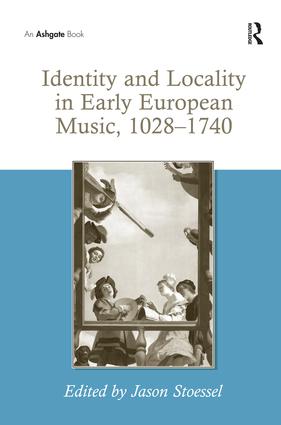
Just in time for your summer or winter reading list–depending on in which hemisphere of the Earth you reside–Routledge has announce that Identity and Locality in Early European Music, 1028-1740, ed. Jason Stoessel, originally published by Ashgate in 2009 has been reissued in an affordable paperback edition. This reissue is part of the Routledge Paperback Direct (RPD) programme and, as such, no changes were made to the hardback edition at all. RPD is the Routledge way of publishing paperback editions of successful hardbacks, available for authors and individual customers to purchase directly from the Routledge website. For further details, see the Routledge order page:
Essay on Death’s influence on the Music of the Fourteenth Century
The following is the English text of a general essay recently published in Dutch in the Laus Polyphoniae 2016 festival program booklet. It names several compositions that featured in the festival program. I am posting it here for the benefit of readers less comfortable with the Dutch version. Continue reading “Essay on Death’s influence on the Music of the Fourteenth Century”
Review of Schiltz’s new book
My review of Katelijne Schiltz’s Music and Riddle Culture in the Renaissance (OUP) has recently appeared in Music and Letters. Full citation:
Jason Stoessel, “Music and Riddle Culture in the Renaissance. By Katelijne Schiltz (review).” Music and Letters 97, no. 2 (2016): 327-329. doi: 10.1093/ml/gcw030
Oxford University Press has provided free access to the review via this link (HTML) or this link (PDF) for use on my personal research blog. Enjoy my review and I hope that it encourages you to read this book on a fascinating topic.
Musical oratory: Johannes Ciconia’s “Con lagreme bagnandome”
I was pleased to see that my article on Johannes Ciconia’s lament Con lagreme bagnandome was published in Plainsong and Medieval Music earlier this month. This article arose from some of the research that I have been undertaking as an associate investigator with the Australian Research Council’s Centre for the History of Emotions. I became interested in how Johannes Ciconia was using using musical elements in this song to emphasise certain textual features, and the relationship between this approach and the revived practice of public oratory in Padua. In the meantime, a better (albeit mostly dry and legalist) picture of Ciconia’s contacts with members of the humanist community at Padua has emerged in recent publications and in my own archival research, although this is not a primary focus of this article. Instead, by looking at humanist literature and intertexts with other Italian sources, I outline my case for Ciconia’s participation in an emotional community of musicians and humanists at Padua, as part of a larger project looking at this trend over several decades in this Veneto city.
Continue reading “Musical oratory: Johannes Ciconia’s “Con lagreme bagnandome””
The Old and New in Early Fifteenth Century Padua
Last week (7-9 April 2015) I had the opportunity to give a talk entitled
Climbing Mount Ventoux: The Contest/Context of Scholasticism and Humanism in early Fifteenth-Century Paduan Music Theory and Practice
It was delivered at this year’s conference of the Sydney Intellectual History Network, which was entitled “Rethinking Intellectual History”, at the University of Sydney. As part of a session of papers discussing the concept of the Ancient and Modern in thirteenth- and fourteenth-century music theory, I spoke about the contrasting approaches of two authors writing in early fifteenth-century Padua: the composer Johannes Cicionia; and the university professor Prosdocimo de’ Beldomandi.
Continue reading “The Old and New in Early Fifteenth Century Padua”
International Symposium on Louise Hanson-Dyer Music ms. 244
ADVANCE NOTICE: INTERNATIONAL SYMPOSIUM ON LOUISE HANSON-DYER MUSIC MS. 244 (LHD 244), UNIVERSITY OF MELBOURNE LIBRARY, 29 MAY 2015 The University of Melbourne Baillieu Library will hold a one-day international symposium “Challenges and conundrums: New research on a little known music theory manuscript at the University of Melbourne”, 29 May 2015. Manuscript LHD 244, despite its diminutive size, comprises more than 20 theoretical texts on musical rudiments and performance from the late 14th to early 17th centuries. Its oldest texts are a compilation of well-known and otherwise totally unknown treatises from the late 14th and 15th centuries. The many later additions include psalm-tones, prayers and more unknown treatises, on composition and organ playing. Speakers include Denis Collins (University of Queensland); Linda Page Cummins (University of Alabama); Jan Herlinger (University of Alabama; Louisiana State University); Jason Stoessel (University of New England); and Carol Williams (Monash University). Kerry Murphy and Richard Excell (University of Melbourne) will briefly place LHD 244 in the context of the Louise Hanson-Dyer Collection. The afternoon will comprise a round table: “Placing LHD 244: Answers and Future Tasks”. If you are interested in receiving formal notification of this symposium, please e-mail Tim Daly, absum [at] netspace.net.au. The symposium will be held in the University Library, Parkville, Melbourne, Australia. A full program will be available and registrations open in early May.
UPDATE: The University of Melbourne Library has announced the symposium here; flyer here.
I say data, you say data
John Stinson and Jason Stoessel, “Encoding Medieval Music Notation for Research,” Early Music 42, no. 4 (2014): 613–17. doi: 10.1093/em/cau093.
What do medieval music and computers have to do with each other, especially since the only “calculators” in the fourteenth century were clever sophists and theologians from Oxford? Well, it turns out quite a bit. The latest issue of Early Music, guest edited by Dan Tidhar, contains numerous articles on the theme of Early Music and modern technology. Several articles examine how computer-assisted research is revolutionising some of the ways music historians can approach medieval music.

Louis II of Anjou and Mod A?
I’ve just had my first fully online, open access journal article published. It’s not the first time my research has been published online, but my previous articles were dual-mode published in print and online. And, in a strange twist that is indicative of the state of medieval musicology in Australia, this is my first article published in this country: all others have appeared in journals published in the United Kingdom, United States and Europe. Anyway, enough of that.
Singing in French at Constance
Last week (19-22 June 2014) I had the pleasure of attending a symposium organised by Stefan Morent, Silke Leopald and Joachim Steinheuer to celebrate the 600th anniversary of the Council of Constance. Entitled the Internationales und interdisziplinäres wissenschaftliches Symposion Europäische Musikkultur im Kontext des Konstanzer Konzils, it was held where else but in Constance on the shores of the lovely Bodensee. Continue reading “Singing in French at Constance”
 Jason Stoessel's Research Blog
You must be logged in to post a comment.